Timor-Leste Program
Building the foundations
of learning
in Timor-Leste.

Community-built public preschools, Timor-Leste’s first play-based After-School Programme, and rigorous evidence of what works.
After-School Programme
Programa Depois Eskola
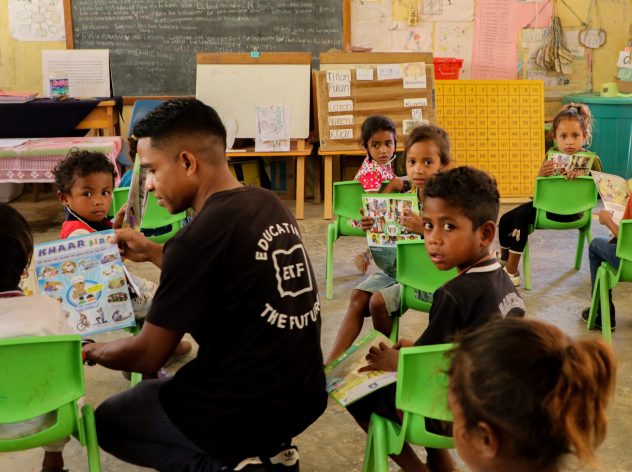
Timor-Leste’s first play-based After-School Programme for children aged 3–7, approved by the Ministry of Education and municipal education offices.
The Challenge
3 in 10
children in Timor-Leste attend preschool
47%+
of children are stunted in some municipalities
~1,000
qualified teachers short
$17
return for every $1 invested in ECE
Children who miss out on early learning start school behind, and many never catch up. Yet every dollar invested in early childhood education returns up to $17 USD to society.
Access to early learning in
Timor-Leste is deeply unequal.
Currently...
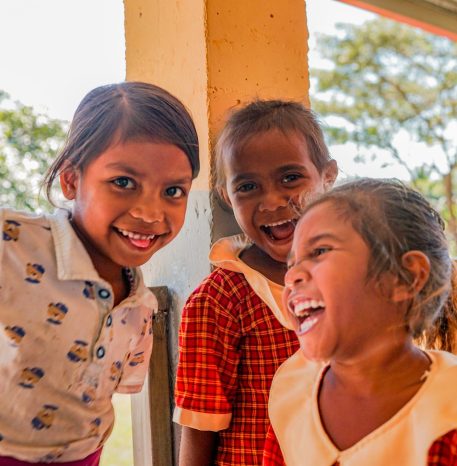
Rural youth have a 37% illiteracy rate, compared with 6% in urban areas, and preschool enrolment ranges from 17% in Oecusse to 79% in Atauro. Nearly 70% of Grade 1 students failed national foundational assessments in 2021.
The Goal...
The Ministry of Education aims to reach 60% preschool enrolment by 2028 and a preschool in every village by 2030. Our programs support these national goals.
Our Public Pre-Schools

Railaco Motahare
Municipality: Ermera
Opened: 2016
Children enrolled in 2026: 42
Children enrolled since opening: 625
Where it all began: Our first preschool, built with the community of Railaco Motahare. Funded by Adam & Alessandro's fundraising.

Fahisoi
Municipality: Aileu
Opened: 2018
Children enrolled in 2026: 61
Children enrolled since opening: 440
Our second preschool and first in Aileu Municipality. Funded by DFAT Australian Government.

Fahiten
Municipality: Liquiçá •
Opened: 2019
Children enrolled in 2026: 36
Children enrolled since opening: 380
Our first preschool in Liquiçá Municipality. Funded by Jayden Gilby.
Saburia
Municipality: Aileu
Opened: 2020
Children enrolled in 2026: 52
Children enrolled since opening: 400
Project evaluation completed in 2025–26, informing how we support School Management Committees. Funded by Australian Government DFAT.
Loi-lubo
Municipality: Baucau
Opened: 2022
Children enrolled in 2026: 60
Children enrolled since opening: 300
Our first preschool in Baucau Municipality. Project evaluation completed in 2025–26. Funded by FFF.
Xanana Nunutali
Municipality: Ermera
Opened: 2023
Children enrolled in 2026: 70
Children enrolled since opening: 250
Equipped with new chairs and tables through the Ministry of Education in 2025–26.
Manleuana
Municipality: Dili
Opened: 2025
Children enrolled in 2026: 86
Children enrolled since opening: 120
A three-classroom preschool, our first in Dili, now maintained by a School Management Committee.
Naguidal
Municipality: Cova Lima •
Opened: 2026
Children enrolled in 2026: 50 •
Children enrolled since opening: 50
Our eighth and newest preschool classroom, and our first in Cova Lima Municipality. Funded by BrITE.
Why after school?
Primary school in Timor-Leste runs for half a day, and over 70% of young children spend their afternoons unsupervised at home, with few books, toys or safe places to play. The After-School Programme turns those hours into structured, play-based learning that complements formal schooling and prepares children for primary school.
Designed with communities
The program was shaped by eight community consultations across six villages. The Ministry of Education approved the pilot in January 2026, and sessions began in March 2026 in Aileu, Liquiçá and Ermera.
How it works
Two trained Timorese facilitators deliver each two-hour session, twice a week, over an eight-week cycle of 16 sessions.
Each session combines:
Learning themes
I Am Special / I Love Myself • Friendship • My “Colourful” Garden • Everything Around Me Matters • Favourite Sport • Explore My Culture • Fun with Technology • Animals
Health and nutrition
Guided handwashing with soap before and after meals, health mini-lessons, and a shared eating circle with nutritious local foods such as cassava, sweet potato, eggs, bananas and papaya, contributed by families.
Inclusion
Our Gender Inclusion Guide and Disability Inclusion Framework ensure mixed-gender play, rotating leadership roles, activities free from stereotypes, and tailored support for children with diverse abilities.
Evaluation 2026
What we found
After-School Programme Evaluation 2026, Executive Summary
Our first full pilot evaluation ran from January to July 2026 at two centres in Railaco, Ermera: EPE Alfredo de Jesus Lemos and EPE Tomas Ximenes. It used a mixed-methods approach: pre- and post-assessments across 10 core learning indicators, a survey of 34 caregivers, and field observation by ETF Project Officers.
98
children enrolled across 2 pilot sites
56%
of participants were girls
10/10
core learning indicators improved
100%
of facilitators met the 80% competency benchmark
Key Findings
Learning gains
Children moved from needing assistance to independent mastery in literacy, basic maths, motor skills and daily hygiene.
Social and emotional development
Clear improvements in following routines, listening and cooperating with peers.
Families
Caregivers reported greater confidence, moving from occasional to consistent support for reading at home and positive discipline.
Local capability
ll four community facilitators met or exceeded the competency benchmark in child-centred, positive-discipline teaching.
Together, these results show the After-School Programme can accelerate school readiness while building a sustainable, community-backed foundation for early childhood education.
Supported by
Embassy of Switzerland to Indonesia, Timor-Leste and ASEAN
USD 23,950 to fund the pilot. The Swiss Ambassador visited the program in Timor-Leste.
Ministry of Education, Youth and Sport and the municipal education offices of Aileu, Liquiçá and Ermera.
Participating communities and families.
Please connect with us if you'd like to support this program or make a donation today!
How we measure impact
We operate with a Theory of Change, a Monitoring, Evaluation and Learning (MEL) Framework and an Evaluation Plan, guided by the OECD DAC evaluation criteria.
- Baseline and follow-up data on enrolment and learning outcomes.
- Community perception surveys with School Management Committees, builders and preschool staff at the start and end of every project.
- Fortnightly site visits during construction, preschool inspections and financial checks.
- Monitoring of outcomes for girls and children with disability.
- Monitoring of fraud, corruption, child protection, PSEAH and environmental risks during field visits.
- Anonymous feedback and complaint mechanisms for communities, in local languages.
In 2025–26 we completed project evaluations of the Saburia and Loi-lubo preschools and a mixed-methods evaluation of the After-School Programme pilot.
Preschool Construction Program
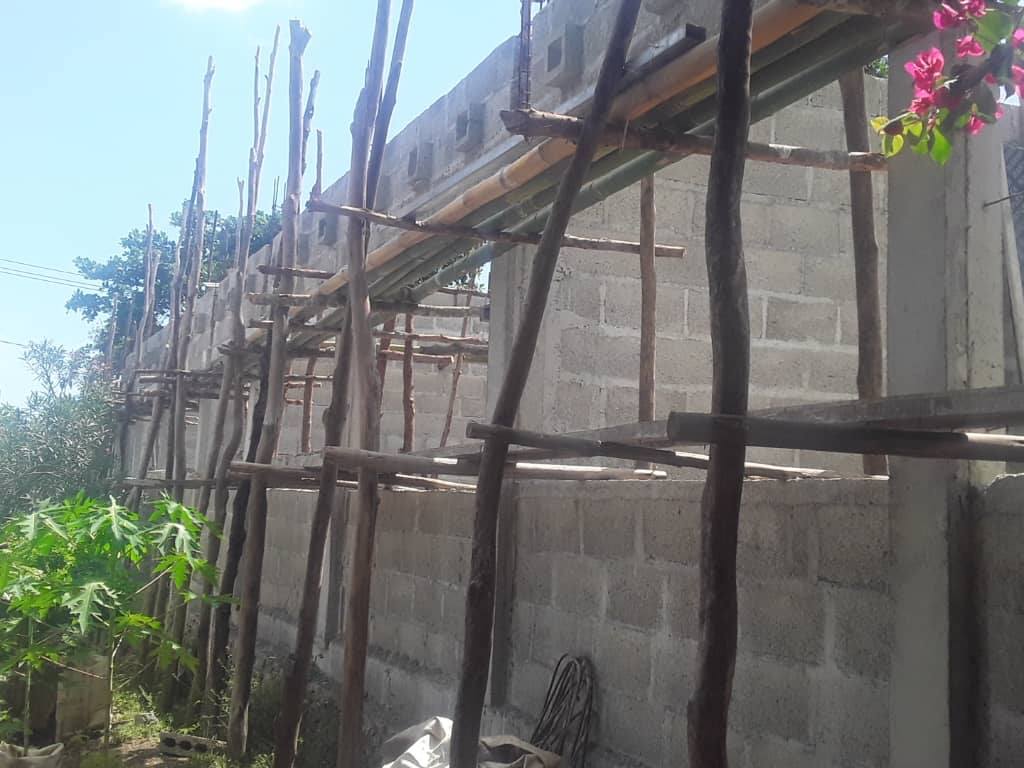
Building community-owned public preschools has been at the heart of Educating The Future since 2015. Every preschool is built by its community and handed over to the Government.
Our approach
Site selection
The Ministry of Education identifies priority communities from its national list.
Community engagement
We visit each site with the Ministry, consult the community and municipality, and establish a School Management Committee working with the Parent Teacher Association.
Community-led construction
Communities build using local techniques, locally sourced materials and local labour, in line with local land laws. We build skills in financial reporting and project management along the way.
Inclusive facilities:
WASH facilities, disability access, electricity, drinking water, gardens and playgrounds.
Handover
Each preschool becomes a public preschool, staffed and resourced by the Ministry, with oversight from the Municipal Director of Education.
This model creates local employment, supports the local economy and ensures each preschool is sustained long after construction ends.